The Code Red Archive
- I. The Emerald Fortress: Inside the Biggest Wave Ever Surfed at Code Red
- II. Ghost in the Machine: The Precision of Defiance
- III. Locus Calvariae: The Geometry of the Emerald Throat
- IV. Pure Adrenaline: The 10-Time Award Winning Perspective
- V. The Maximus Effect: Ocean Harmony as Fine Art
- VI. Investing in the Apex: Wall Fine Art for the Elite
The Emerald Fortress: Inside the Biggest Wave Ever Surfed at Code Red
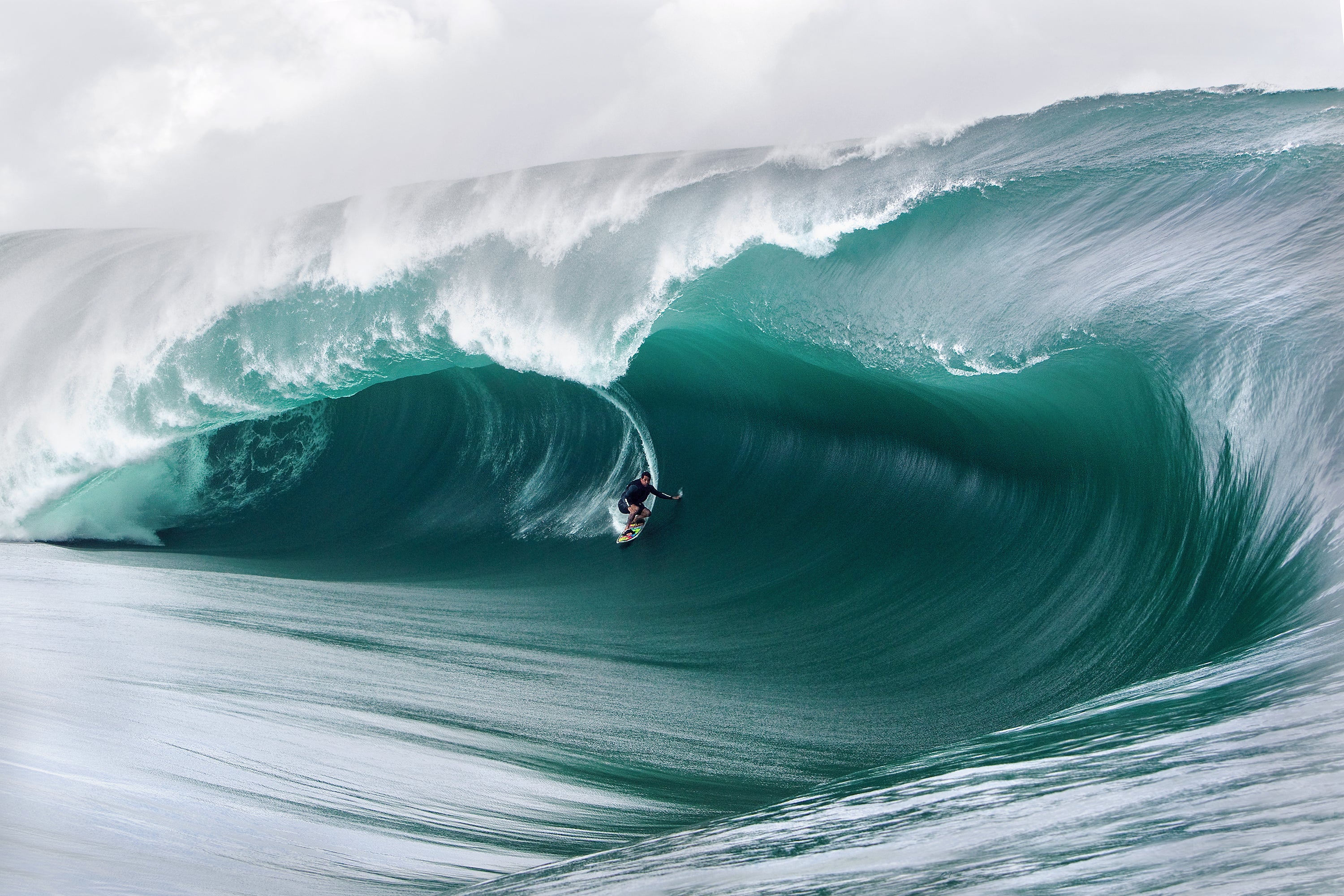
August 27, 2011, did not begin as a typical day in the South Pacific; it began as a confrontation with the Maximus scale of the natural world. This was the arrival of the “Code Red” swell, a meteorological anomaly born from a massive low-pressure system in the Southern Ocean that sent shockwaves toward the Tahitian coastline. At the “End of the Road,” the legendary Teahupo’o—known historically as the Locus Calvariae or the “Place of Skulls”—the atmosphere was heavy, bruised, and terrifyingly silent. The ocean had ceased its rhythmic breathing and had transitioned into a state of tectonic surging. The Tahitian Coast Guard, recognizing the lethal potential of the day, declared a forbidden zone, yet the lure of the biggest wave ever surfed at this location acted as a siren song for the elite.
As the first sets hit the reef, the water underwent a startling transformation. It was no longer the inviting turquoise of a postcard; it had become a predatory emerald, a liquid mountain that had reached a breaking point of impossible physics. The sheer volume of water moving over the shallow volcanic shelf created a vacuum that seemed to pull the very air out of the sky. This was the “Emerald Fortress,” a structure of large waves that existed for only seconds but carried the energy of an entire season. For the collector of fine art, this photograph is not merely an image of water; it is a visual dissertation on the moment the Pacific reached its absolute zenith of power.
The “Code Red” event was a documentary of survival. The thickness of the lip—often described as being as heavy as lead and as wide as a fortress wall—created a profile that looked less like a wave and more like the ocean folding in half. When you stand before this wall fine art, you are witnessing the Spiritus Invicta of the planet. The emerald hue is so deep it feels abyssal, a color that suggests both the beauty and the danger of the deep ocean. This is why the piece is considered a cornerstone of any high-end collection; it captures a historical anomaly that may never be repeated in our lifetime.
Ghost in the Machine: The Precision of Defiance
Within this emerald chaos stood a man who chose to ignore the forbidden mandate. Everaldo “Pato” Teixeira became the “Ghost in the Machine,” a tiny testament to human precision within a landscape of total destruction. As Pato committed to the 50-foot face, the world around him effectively vanished. The sheer verticality of the drop meant that for several heartbeats, he was navigating a near-perpendicular wall of liquid glass. This is the moment where pure adrenaline meets fine art—a second of perfect clarity inside the throat of a monster.
Look closely at the silhouette in the image. Pato is positioned at the absolute limit of what is physically survivable. He is navigating a narrow corridor between immortality and the razor-sharp reef—the “Place of Skulls”—which lies only inches beneath the churning foam. The velocity required to stay ahead of that pitching lip is terminal. In this large wave capture, the shadow cast by the crest effectively eclipses the Tahitian sun, plunging the surfer into a twilight of his own making. It is a moment of In Extremis, where every muscle fiber and neural pathway is firing in a desperate symphony of survival.
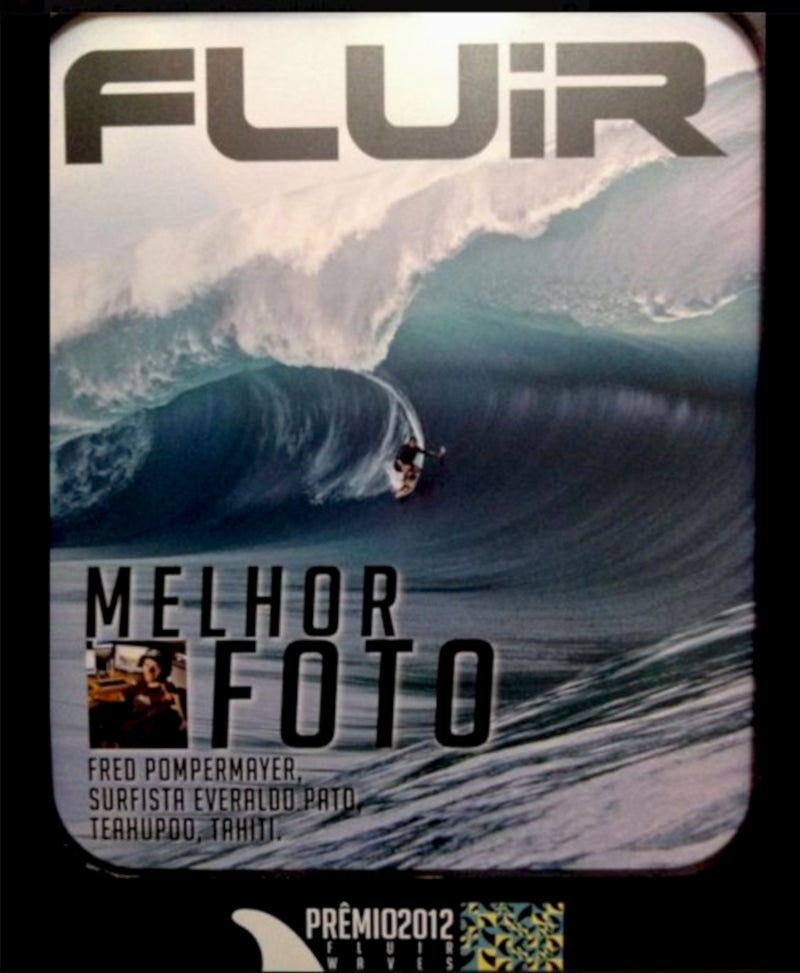
This defiance is what makes Fred Pompermayer’s work so compelling to the discerning buyer. It is not just the wave; it is the human spirit acting as a Memento Vivere (Remember to live) against a backdrop of Mors Tua Vita Mea (Your death is my life). The lip above Pato carries the weight of a thousand collapsing buildings, pitching forward with a roar that was heard miles inland. To witness this through a lens of wall fine art is to feel the outcome of true bravery. It is a romantic, high-action testament to the day the Pacific became a deity, and one man dared to look it in the eye.
The “Ghost in the Machine” narrative is about the mastery of fear. As Pato carved his line across that emerald face, he wasn’t just surfing; he was engaging in a visual dissertation on the eternal pursuit of the impossible. The image survived a wipeout that would have broken lesser men, preserved now in museum-quality detail. For those seeking stunning wall arts for decor, this piece offers a sense of harmony born from the most violent conditions imaginable. It is a grounding force for any architectural space, providing a Blue Mind perspective that only the most extreme ocean conditions can provide.
The Lens of Pure Adrenaline: Fred Pompermayer
To capture large waves of this magnitude requires a photographer who lives in a state of permanent pure adrenaline. Fred Pompermayer is that photographer. Positioned not on a distant shore, but in the heart of the impact zone, Fred’s “total immersion” style allows the viewer to feel the weight of the water. This isn’t just a photo; it is an outcome of decades spent at the pinnacle of the craft. Fred is a 10-time Big Wave Award winner and a 2-time Guinness World Record photo contributor, and his authority is etched into every detail of this fine art print.
The Maximus Effect: Ocean Harmony as Fine Art
For the high-end collector, stunning wall arts for decor provide a unique psychological benefit: the Blue Mind effect. Even in its most Maximus and terrifying form, the ocean triggers a sense of harmony and cognitive clarity. Hanging this 50-foot emerald fortress in a room provides an anchor of perspective. It reminds us of the scale of the planet and the courage required to navigate its most extreme environments. Investing in Fred Pompermayer’s work is an investment in a legacy of extreme pursuit and artistic obsession.