The Archive of the Monolith
- I. Prologue: The Northern Purgatory
- II. The Descent: Jamie Mitchell and the Vertical Nightmare
- III. The Monolith: Physics of the 80-Foot Void
- IV. The Lens of Authority: Fred Pompermayer’s Pure Adrenaline
- V. Blue Mind Philosophy: The Outcome of Harmony
- VI. The Collector’s Anchor: Wall Fine Art as Legacy
Into the Void: The Architecture of Terror and the Mastery of the Monolith
December 20, 2014. The atmosphere over Half Moon Bay did not merely shift; it curdled. The Northern California air was a razor, a frigid blade that cut through neoprene and bone alike. At Mavericks, the Pacific doesn’t offer a welcome; it offers a trial. This is a place of Gravitas—where the ocean ceases to be a playground and becomes a moving mountain range of dark, primordial energy. In this freezing purgatory, the horizon had disappeared, replaced by a skyscraper of water that looked less like a wave and more like a tectonic event.
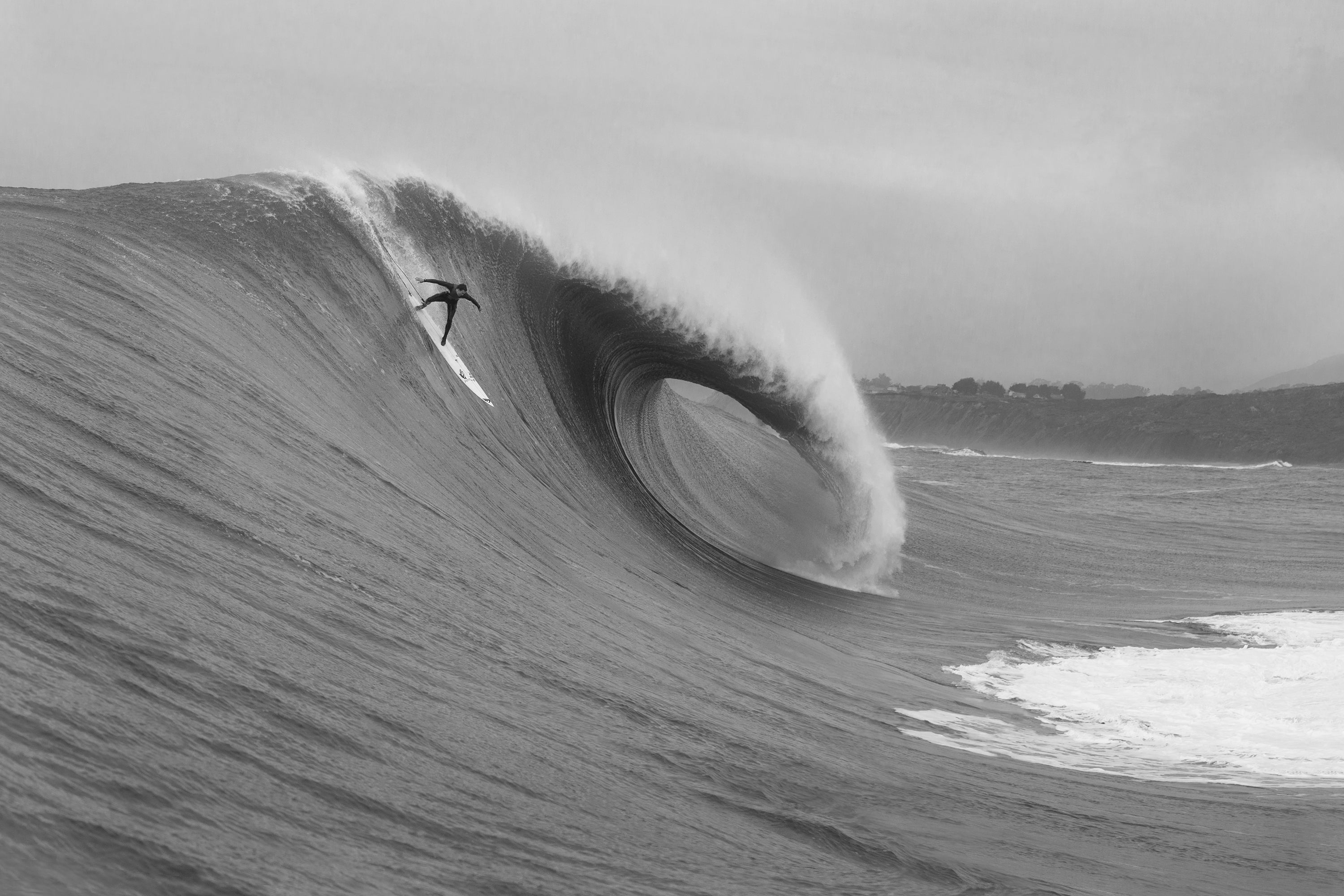
Jamie Mitchell sat on a sliver of foam, a solitary soul at the gates of the abyss. To the uninitiated, it looked like a suicide mission. To the elite, it was the ultimate Memento Vivere—a reminder that to truly live, one must occasionally stand at the edge of the impossible. This was the birth of “Into The Void,” a moment captured in stark, timeless monochrome that would redefine the visual language of big waves forever.
The Descent: A Human Shadow in a Vertical Nightmare
When Mitchell committed to the set, the world tilted. This wasn’t a standard take-off; it was a freefall into a monolith of shifting mercury. In the photography of Fred Pompermayer, we see the scale of human defiance. Mitchell appears as a mere speck, a shadow chasing a line through an 80-foot fortress of water. The sheer verticality of the drop is enough to induce vertigo in the viewer. It is a visual dissertation on the Abyssus Abyssum Invocat—the deep calling unto the deep.
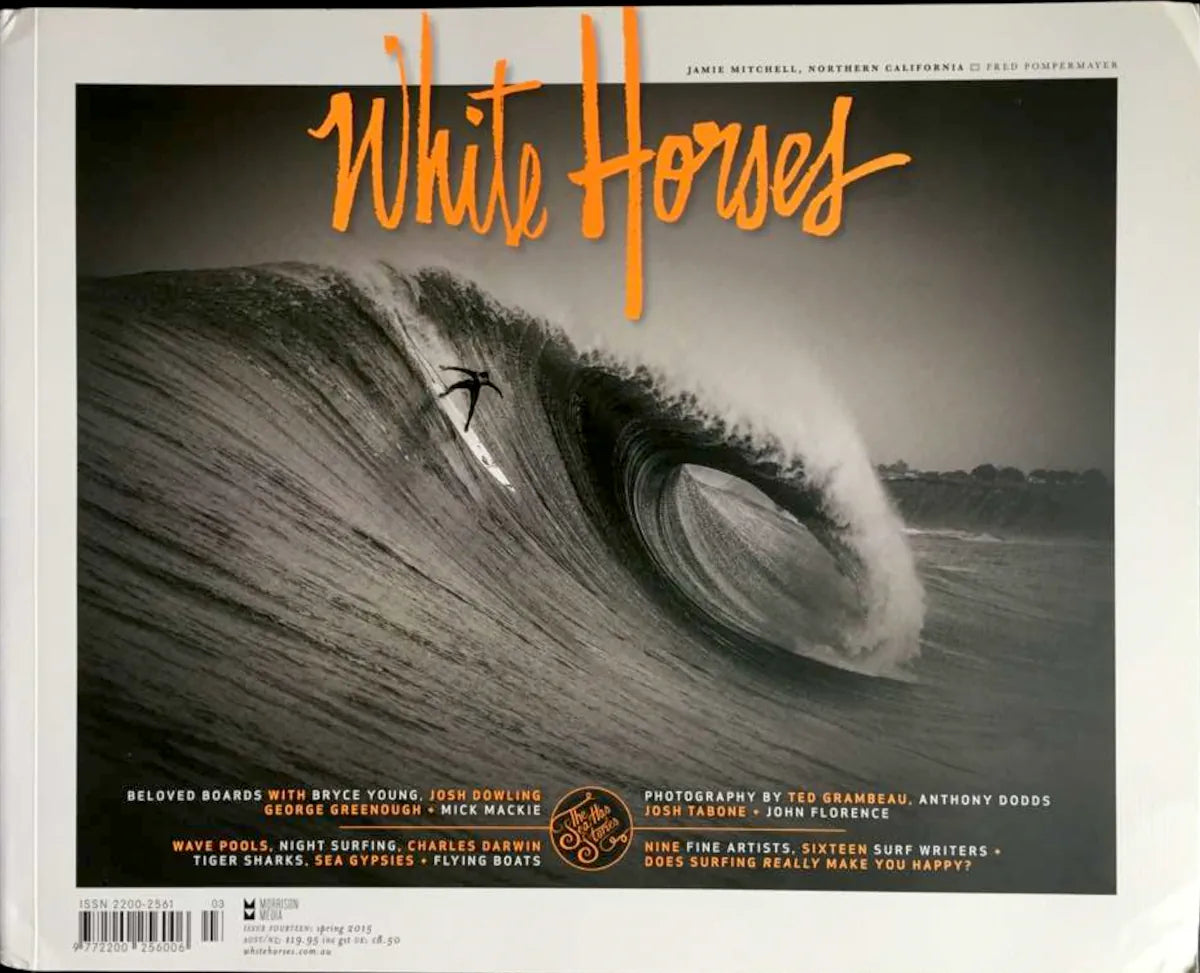
The speed was terminal. At Mavericks, the reef is a labyrinth of granite and shadow, shark-patrolled and unforgiving. As Mitchell plummeted, he wasn’t just riding a wave; he was navigating a liquid avalanche. This specific ride became legendary not just for its height, but for its consequence. It simultaneously entered the annals of history, nominated for both “Ride of the Year” and “Wipeout of the Year” at the 2015 WSL Big Wave Awards. It was a moment of pure adrenaline that ended in a “savage beating”—a white-water eclipse that swallowed Mitchell whole, proving that at this level, the ocean does not just break; it hunts.
The Monolith: The Physics of Heavy Water
To understand why this is one of the biggest waves of the history, one must understand the physics of the monolith. A wave at Mavericks carries the kinetic energy of a city block in motion. When that lip—thick enough to crush steel—begins its descent, it creates a vacuum of pressure. Mitchell was dropping into a “void” where the air itself is compressed by the weight of the Pacific. This is the “Heavy Water” philosophy that Fred Pompermayer has spent a lifetime documenting. It is a landscape of violence turned into fine art.
For the collector, this image represents the absolute apex of large waves photography. It is not a “pretty” picture of the beach; it is a documentary of survival. It is a window into a moment where a human being endured a pressure few could imagine, captured with a clarity that only a 10-time Big Wave Award winner could achieve.
The Lens of Authority: The Fred Pompermayer Legacy
Why does Fred’s work command such respect among rich buyers and museum curators? Because Fred is not a spectator. He is an inhabitant of the impact zone. While others shoot from the safety of the cliffs, Fred is in the “pocket,” face-to-face with the monster. This “total immersion” style is what gives his wall fine art its soul. You aren’t just looking at the wave; you are feeling the spray, the cold, and the pure adrenaline of the moment.
- 10-Time Big Wave Award Winner: A record that stands as a testament to his obsession with the truth of the ocean.
- 2-Time Guinness World Record Contributor: Documenting the largest waves ever successfully navigated by mankind.
- 50+ International Magazine Covers: His vision defines the global aesthetic of the extreme.
When you acquire a piece from this series, you are displaying the work of a world-renowned authority. This is the pedigree of stunning wall arts for decor. It is an investment in a legacy of calculated risk and technical brilliance.
The Blue Mind Outcome: Harmony in Chaos
There is a psychological phenomenon known as the Blue Mind effect. It suggests that humans have a biological connection to water that triggers a state of harmony and cognitive clarity. But how does an 80-foot monster wave provide harmony? It provides it through perspective. When you look at “Into the Void” on your wall, your own daily stresses appear microscopic. It serves as an anchor—a visual reminder of the scale of the world and the resilience of the human spirit.
This is the outcome for the buyer: an environment of Blue Mind focus. In a high-end architectural space, this monochrome masterpiece acts as a grounding force. It brings the “Heavy Water” spirit into the home, transforming a room into a gallery of inspiration. It is wall fine art that speaks of power, elegance, and the eternal pursuit of the impossible.
Investing in the Impossible: The Ultimate Decor
The “Monolith” of 2014 stands as a top contender for the world’s biggest wave ever surfed in California. For the discerning decorator, this is the ultimate large waves ocean statement. It is a portal into the raw, unedited power of nature, preserved in museum-quality detail on metal or paper. Every print carries the weight of the session, the authority of the artist, and the spirit of the void.